
DIY ELECTRONIC PERCUSSION · STEAM+C
Turn a bucket into a drum kit.
Students build drums from 5-gallon buckets, add a piezo sensor to each pad, and program a microcontroller that turns their hits into sound.
Where BOM is today: a classroom prototype. This fall we're talking with educators about how hands-on projects go in their classrooms.
HOW IT WORKS
From a hardware-store bucket to a drum students can play and program.
01 · BUILD
Make the drums
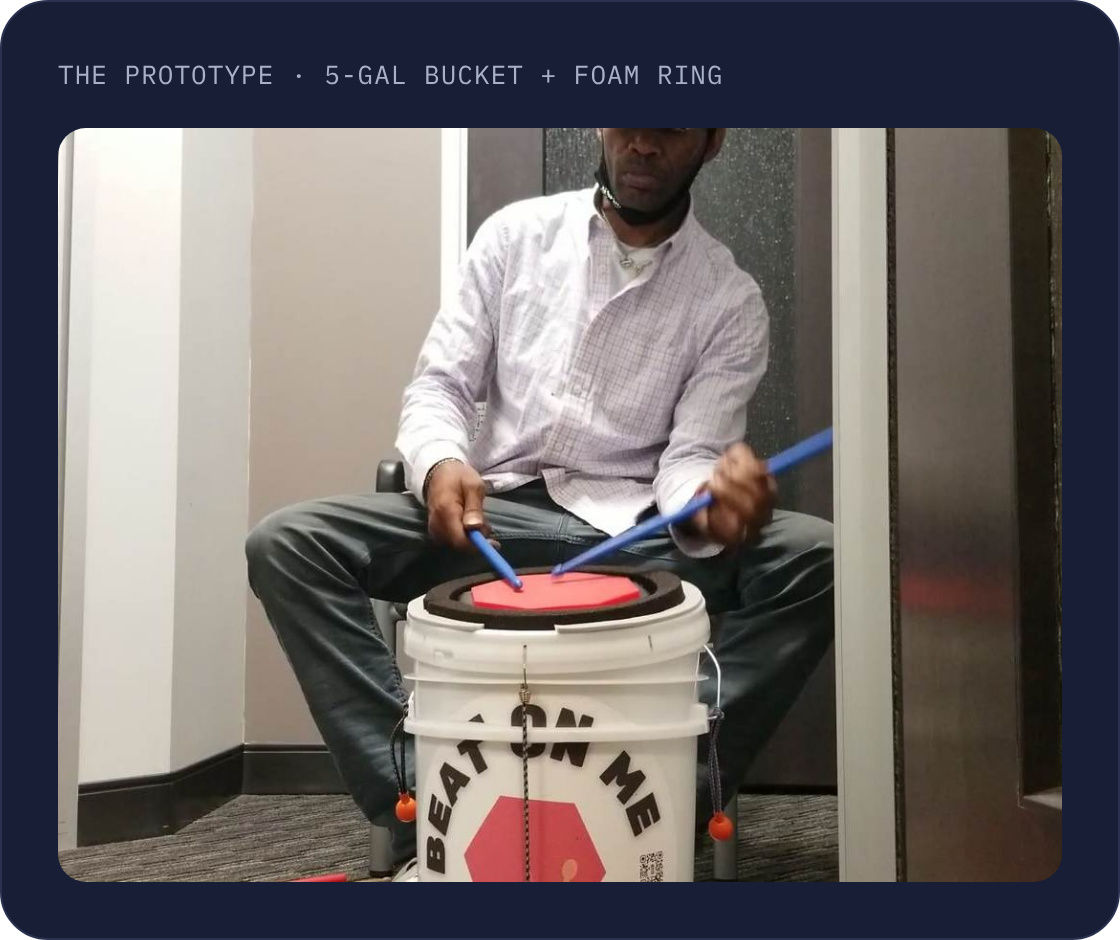
Students make each drum from a 5-gallon bucket, a playing pad, a foam ring and elastic lacing.
02 · SENSE
Add piezo sensors
A piezo disc under each pad turns a hit into a voltage. Three small parts per drum keep that signal safe for the board and let it settle between hits.
03 · CODE
Program the board
A microcontroller reads every drum. Students decide how hard a hit must be, how long to ignore the ringing, and what each drum plays.
04 · PLAY
Hear each hit
Our draft code gives each drum its own pitch on a small buzzer. We haven't tested it on the drums yet. For real drum sounds, we're exploring MIDI.
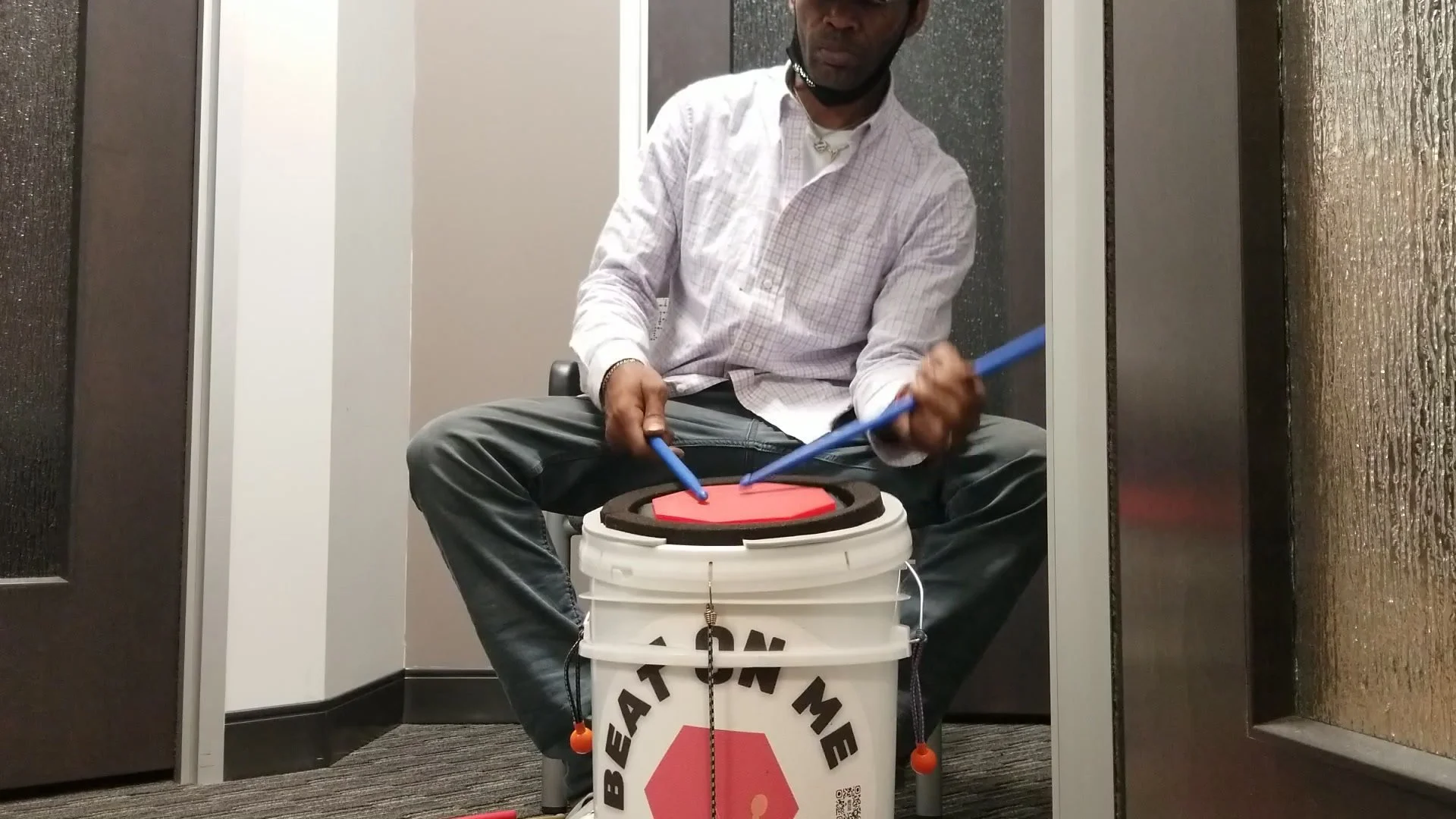
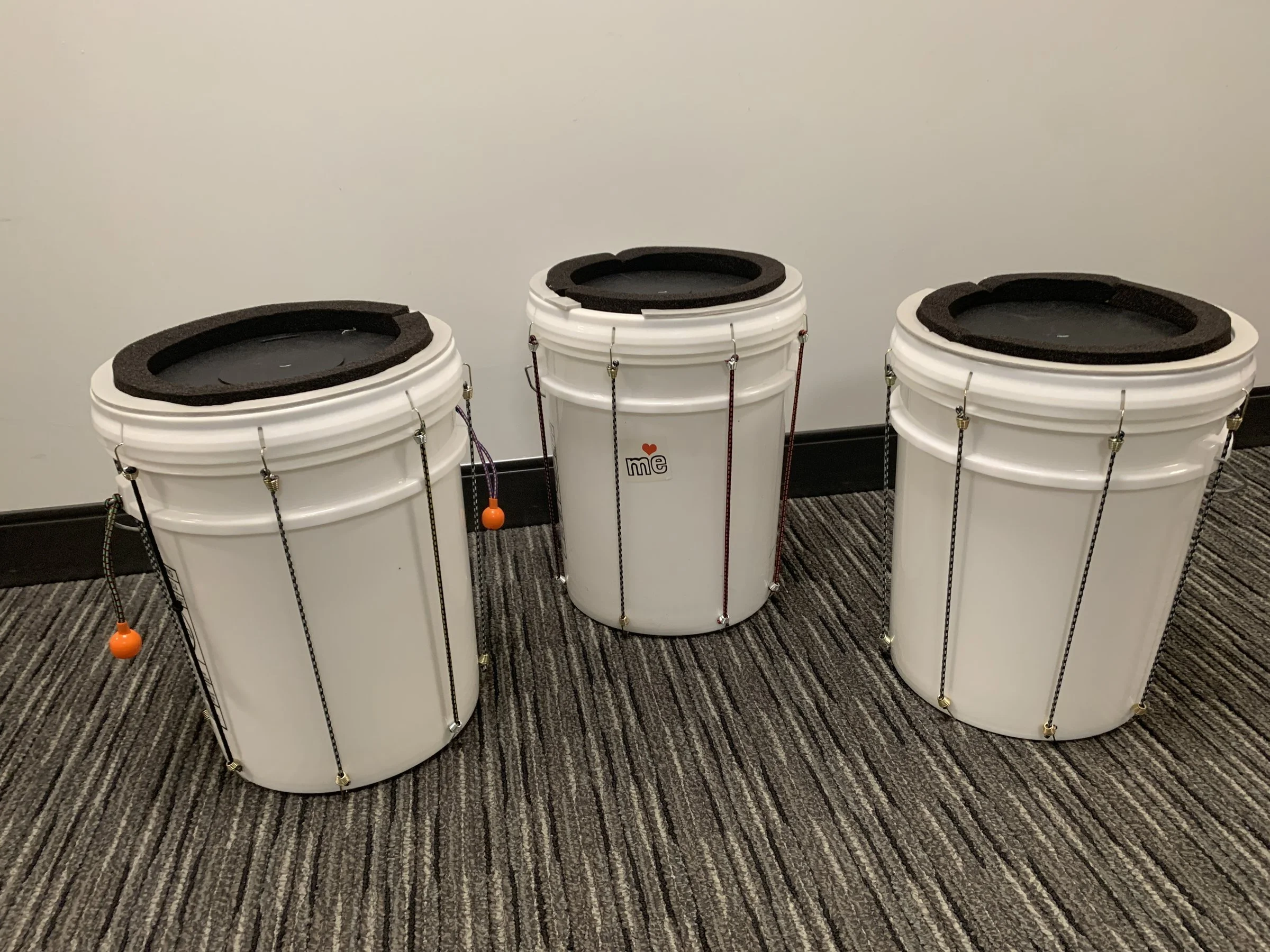
THE PROTOTYPE
Three drums from 5-gallon buckets.
Our classroom prototype has three bucket drums. Every student build will come out a little different, and comparing them could become part of the lesson.
PROPOSED RESEARCH · ADAPTIVE SIGNAL CONDITIONING
Every bucket rings differently. Could the kit adjust?
Student-built pads differ in size, material, foam and tension. A trigger setting that works on one drum can miss soft hits or play extra notes on another. Our research goal is firmware that measures how each pad responds and adjusts to it, so teachers don't have to hand-tune every student's drum.
- Auto-calibration that would learn each pad's soft and hard hits
- Noise filtering that would separate real hits from bumps and electrical noise
- Crosstalk suppression that would keep one drum from triggering its neighbors without dropping real hits played together
- Thresholds that would follow how each drum actually rings, instead of one preset setting for every drum
These are proposed research goals. None of them is working yet. Our untested draft code uses simpler preset rules, the same for every drum.
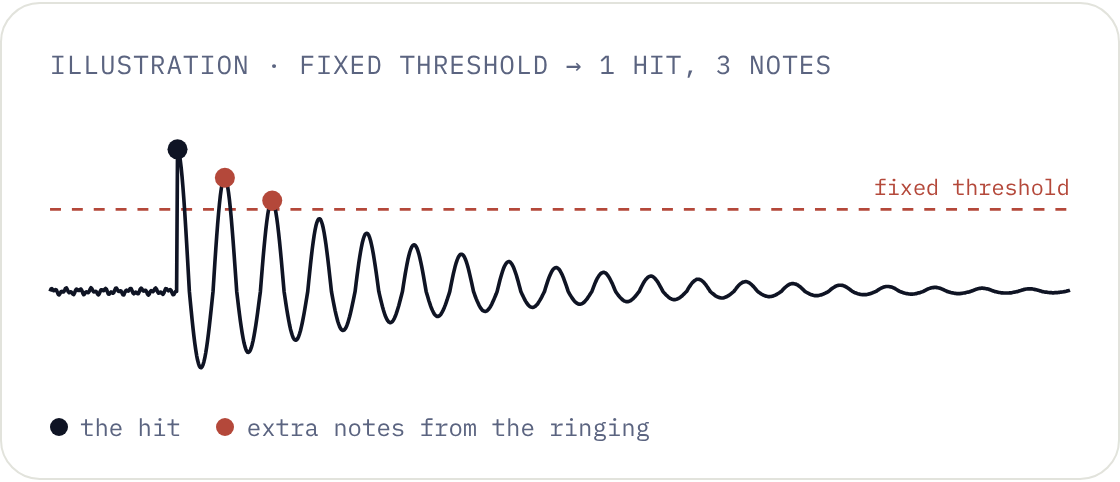
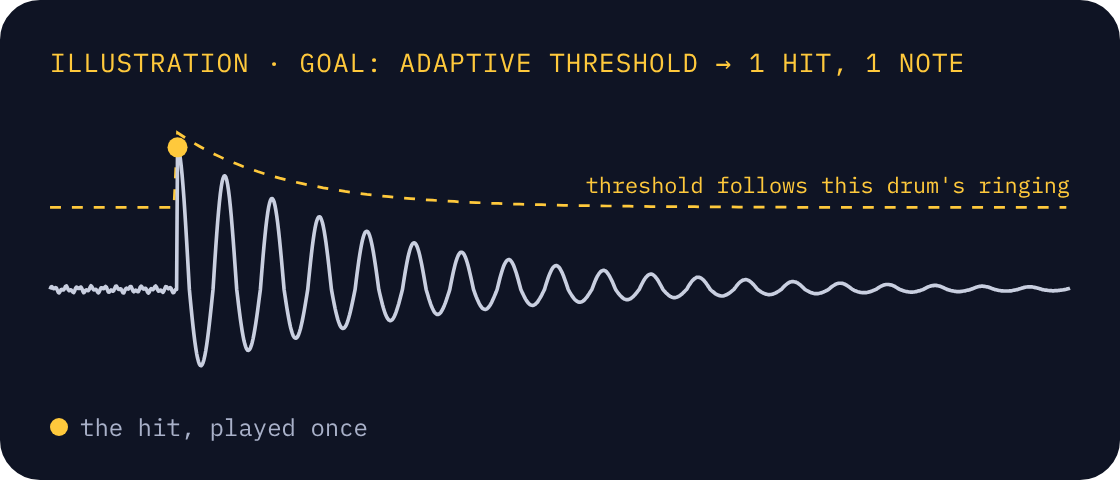
Drawings of the idea, not measured data.
FOR CLASSROOMS AND MAKERSPACES
Hands-on music technology for every letter of STEAM+C.
CTE electronics and coding
Sensors, circuits and code in one project that ends with an instrument students can play.
Music and STEAM
Students build the instrument they perform on and connect rhythm to the physics of sound.
Makerspaces
A build from common materials that rewards testing and iteration.
Science · Technology · Engineering · Arts · Math · + Computing
PARTS LIST
Parts in our draft circuit
For the three-drum prototype. This is a draft circuit we haven't tested on the drums yet, not a final parts list. A classroom kit may differ.
| Part | Role | Qty |
|---|---|---|
| Bucket, playing pad, foam ring, elastic lacing | Drum body and playing surface | 3 sets |
| Piezo disc | Senses each hit | 3 |
| 1 MΩ resistor | Lets the signal settle between hits | 3 |
| 5.1 V zener diode | Protects the board (even ordinary hits can go over 5 V) | 3 |
| 10 kΩ resistor | Limits current into the board | 3 |
| Arduino Uno or Nano | Reads the drums and runs the code | 1 |
| Passive buzzer + resistor: 100 Ω for a piezo buzzer, 220 Ω for a magnetic one | Meant to play a short tone for each hit | 1 |
ABOUT
Who's building BOM
BOM (Beat On Me) is associated with MIE Music Science and Technology. MIE is pronounced “me.” BOM brings instrument building together with electronics, coding, music, math and physics.


Robert Rucker
Founder and Entrepreneurial Lead
A K–5 music teacher in New Jersey, a jazz drummer, and the founder of Music In Everything Corporation. Robert leads BOM's work with educators.
Jaykyun (Jay) Cho
Technical Lead
Hamilton Zhi
Co-Technical Lead
This fall, the BOM team is taking part in NJIT's I-Corps Propelus program, interviewing teachers and school leaders about hands-on learning before deciding what to build next.
QUESTIONS
Questions educators ask
Can I buy a BOM kit?
Not yet. BOM is a classroom prototype. We're talking with educators first to learn how hands-on projects run in schools.
Which grades is it for?
We're exploring fit with K–5 music and STEAM classes, secondary CTE programs and makerspaces. Tell us about your students.
What equipment does it use?
The prototype drums are 5-gallon buckets with playing pads, foam rings and elastic lacing. Our draft circuit adds a piezo sensor to each drum and an Arduino Uno or Nano. Uploading code to the board needs a computer with the free Arduino software.
Can my school try it?
We're not running pilots right now. If you'd like to tell us about your program, use the form below.
TALK WITH US
Tell us how hands-on projects go.
We're early. Before we decide what to build next, we want to understand how hands-on projects actually run in schools. We'd especially like to hear:
→ How your last electronics, coding or music-tech project went
→ What took the most preparation or class time
→ How your school chooses and pays for new kits or programs